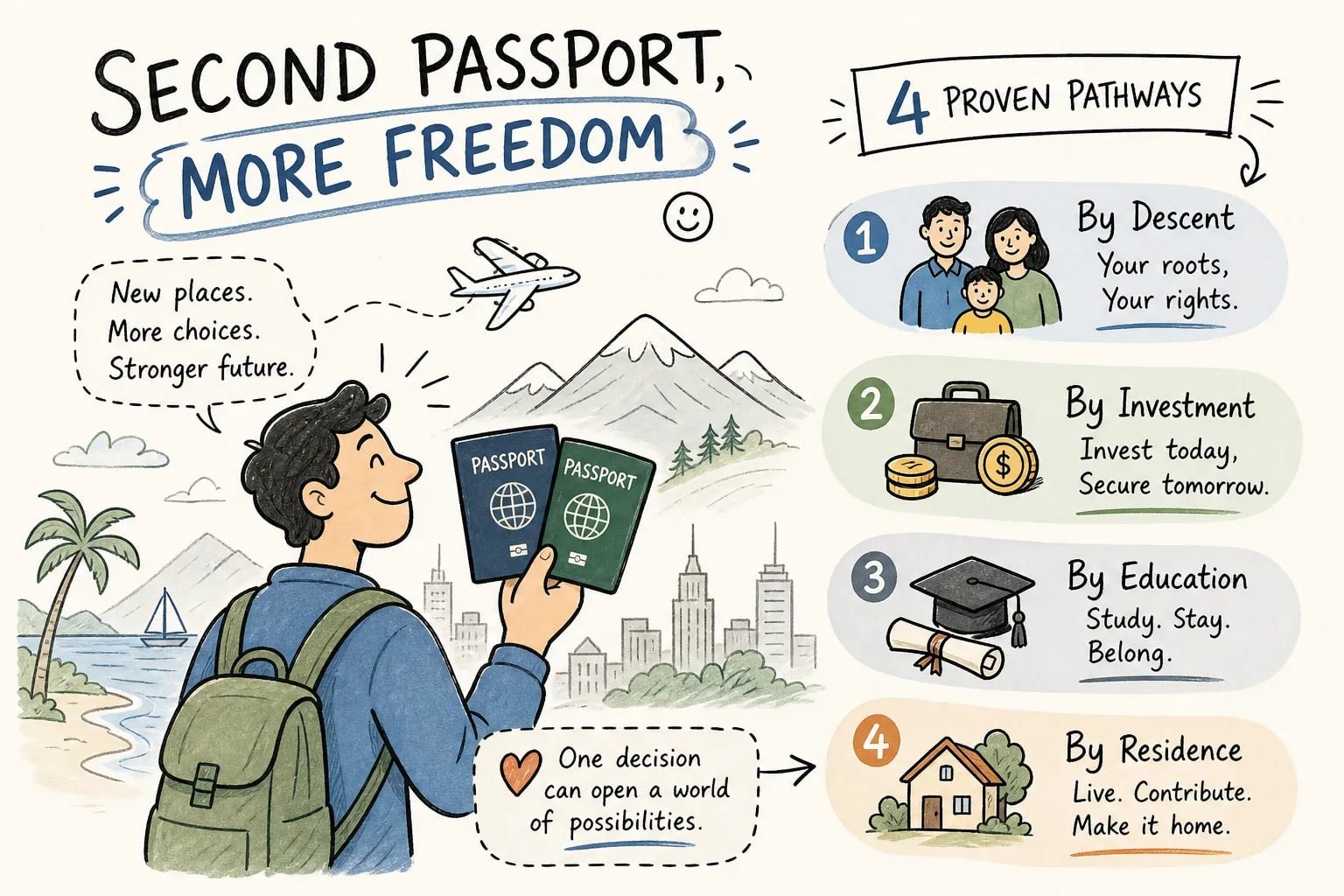
A legal second passport is within reach for more Americans than most people realize, and the reasons people pursue one are rarely what you’d expect. Not secrecy. Not tax evasion. The real motivations are practical: a backup if geopolitical conditions shift, broader visa-free travel, or the ability to plant roots in another country without burning bridges at home. The U.S. government permits dual nationality and does not require you to renounce your citizenship when you naturalize elsewhere. That door is open. The real question is which path through it fits your life.
There are four legal routes to a second passport: citizenship by descent, naturalization through residency, citizenship through marriage, and citizenship by investment. Each one suits a different type of person, budget, and timeline. At Travel Documents Online, we guide clients through all four of these pathways regularly, drawing on years of hands-on experience with international document preparation and application coordination. This guide cuts through the noise so you can identify your best route before you spend a dollar or file a single form.
1. Getting a legal second passport through citizenship by descent
The most underused pathway is often the most powerful one. If you have a parent, grandparent, or in some cases a great-grandparent from Italy, Ireland, Germany, Portugal, or several other countries, you may already be entitled to a second passport without spending anything on an investment program. The key variable isn’t how far back your lineage goes; it’s whether citizenship was maintained or lost somewhere along the chain.
Which countries allow descent claims and how far back they reach
Italy follows jure sanguinis rules, meaning citizenship passes through the bloodline across multiple generations in theory. The chain just needs to be unbroken, with no ancestor having naturalized elsewhere before passing citizenship on to the next person in the line. Ireland generally reaches to the grandparent level, with some routes requiring that a parent registered before the applicant’s birth. Germany expanded access significantly after 2024 reforms, now allowing dual citizenship rather than requiring renunciation. Canada and the UK are generally more restrictive, limiting descent claims to one generation born abroad.
The paper trail you’ll need to build your case
Every descent claim rests on documents. You’ll need birth certificates for every person in the chain, marriage certificates to prove name changes and parent-child links, and naturalization or non-naturalization records confirming the ancestor held onto their original nationality. Certified copies, translations, and apostilles are required wherever foreign-issued documents are involved. The records most often missing are the ancestor’s naturalization documents, and that’s exactly where most descent claims hit a wall.
Italy has one of the most expansive programs, but consular backlogs at many U.S.-based Italian consulates have been running one to three years, with wait times varying significantly by jurisdiction. Ireland’s process is more structured but demands precise generational evidence. Both programs produce genuinely strong passports, Italy, Ireland, and Portugal are among the European countries whose passports carry full EU rights, which makes the effort worthwhile for anyone who qualifies. If there’s a plausible family connection, check this route first before committing to any investment.
2. Naturalization and marriage: the long-game pathways that actually work
Not everyone has a qualifying ancestor. For most Americans, earning the right to a dual citizenship passport means establishing legal residency in another country first, then applying for naturalization after meeting the required years of continuous presence. It takes time, but the result is a genuine, permanent second citizenship without a large capital outlay.
The fastest naturalization timelines by region
Argentina stands out as one of the fastest globally: two years of continuous legal residency and you’re eligible to apply. You also need to be physically inside Argentina when you file, and rule changes that took effect in 2025 mean most applicants treat the two-year period as genuinely continuous, with minimal time outside the country. Paraguay and the Dominican Republic each offer pathways in the three-year range. Uruguay also offers an accelerated path, typically three years for married applicants, though single applicants generally face a five-year requirement, so confirm your situation before planning around that timeline. Portugal, France, Germany, and Ireland all sit at the five-year standard, though Portugal’s Golden Visa route involves remarkably minimal physical presence, roughly seven days per year under current program rules, making it a realistic option for Americans who can’t relocate full-time. Italy and Spain require ten years for most applicants, which rules them out for anyone without patience or existing roots there.
One distinction that trips people up: „legal residency“ and „physical presence“ are not the same requirement. Some countries require you to genuinely live there. Others mainly require lawful status with limited absences. Confirming which one applies before you commit to a country saves years of planning around the wrong set of rules.
How citizenship through marriage works differently
Most countries offer a shortened naturalization timeline for foreign spouses of their citizens, typically two to four years rather than the standard five to ten. What marriage citizenship is not, in almost every country, is instant citizenship upon marriage. Residency requirements still apply, and so do language tests, civics knowledge, tax compliance, and a clean criminal record in most cases. The marriage route accelerates the clock; it doesn’t eliminate it.
3. Citizenship by investment: the premium fast-track option in 2026
For high-net-worth individuals with a clear budget and a tight timeline, citizenship by investment (CBI) programs are the most direct legal route to a second passport. Instead of years of residency, you make a qualifying investment and receive citizenship after a due-diligence review. The tradeoff is cost: these programs require real capital.
Active CBI programs and what they actually cost
The current CBI market in 2026 offers a range of entry points. São Tomé and Príncipe and Nauru have both been offered at entry points around USD $95,000, placing them among the lowest-cost programs globally, with processing times reported at roughly two to five months, though pricing and availability for these programs can vary, so confirm current terms directly. Vanuatu starts at $130,000 and consistently ranks among the fastest programs, with processing around two months.
Moving up the cost scale, the Caribbean programs carry higher minimums but strong track records. Dominica starts at $200,000 with four to six months of processing. Grenada comes in at $235,000 with six to nine months. St. Kitts and Nevis, one of the oldest CBI programs in the world, is priced at $250,000 with four to six months of processing. Turkey’s real estate route starts at $400,000 with roughly eight to twelve months of processing.
Beyond the minimum investment, every program also carries government due-diligence fees, application fees, and administrative costs that vary by family size and the route chosen. Budget for those separately; the headline figures above are entry points, not total-cost figures.
Why Caribbean programs appeal specifically to American investors
The five Caribbean programs, Antigua and Barbuda, Dominica, Grenada, St. Kitts and Nevis, and St. Lucia, are among the most frequently chosen by U.S. clients, largely because of processing speed and visa-free access. Grenada has a specific advantage worth noting: a Grenadian passport opens the door to the E-2 Treaty Investor Visa pathway into the United States, a route not available to U.S. passport holders applying directly. For entrepreneurs and investors who operate internationally, that’s a meaningful strategic option. St. Kitts and Nevis has consistently maintained rigorous due-diligence standards, which matters for the passport’s long-term acceptance and visa-free strength.
At Travel Documents Online, we guide clients through the full CBI application process: program selection, due-diligence preparation, and end-to-end document coordination, handled confidentially from start to finish.
Donation route vs. real estate route: what you’re actually choosing
Most CBI programs offer at least two routes. The donation route is a non-refundable government contribution. The real estate route involves purchasing approved property that must be held for a set period before it can be sold. Donation routes are simpler, faster, and lower in total complexity. Real estate routes tie up capital during the holding period but carry the possibility of a return through resale or rental income. The right choice depends on whether the client values simplicity or wants a recoverable asset at the end of the holding period.
4. Legal and tax realities Americans face with dual nationality
This is the section most online guides skip, and it’s the one that matters most for U.S. citizens. Acquiring a second passport does not reduce your U.S. tax obligations. Understanding this upfront prevents expensive surprises.
The U.S. worldwide income tax rule that stays with you
The U.S. taxes its citizens on worldwide income regardless of where they live or which passport they travel on. Filing requirements do not disappear once you hold a second passport. The Foreign Earned Income Exclusion and Foreign Tax Credits can reduce double taxation in many situations, but they don’t eliminate the annual filing obligation. Acquiring a second citizenship is not renunciation of U.S. citizenship. You remain a U.S. taxpayer unless you go through the formal renunciation process, a separate legal action with its own significant financial and legal consequences.
FATCA, FBAR, and foreign account reporting
U.S. dual citizens with foreign bank accounts continue to face FBAR reporting requirements when aggregate foreign account balances exceed $10,000 at any point during the year. FATCA Form 8938 thresholds are higher and depend on where you live:
- U.S.-based filers: $50,000 on the last day of the year, or $75,000 at any point during the year
- Americans living abroad: $200,000 on the last day of the year, or $300,000 at any point
A second passport doesn’t change these obligations. They follow U.S. citizenship status, not which passport sits in your pocket.
Military service and entry and exit document rules
Some CBI and naturalization countries impose military service obligations on their nationals. According to U.S. State Department dual nationality guidance published at Travel.State.Gov, dual nationals may be subject to those requirements when present in the foreign country. Separately, U.S. citizens are required to enter and exit the United States on their U.S. passport, regardless of any other nationality they hold. Men in eligible age ranges also remain subject to U.S. Selective Service registration requirements even if they hold foreign nationality.
How to pick the right pathway for your situation
After reviewing the four options, the right route usually comes into focus quickly once you weigh three honest questions against your timeline, budget, and eligibility.
Do you have documented family heritage in a country with a citizenship-by-descent program? If yes, check that pathway first. It costs the least, produces the strongest long-term outcome, and a passport by descent from certain European countries, Italy, Ireland, and Portugal among them, carries full EU rights. The documentation burden is real, but the reward is proportional.
Are you willing and able to establish legal residency abroad for two to five years? Naturalization through residency produces a genuine, permanent second citizenship without a large capital outlay. Argentina, Paraguay, Portugal, and Ireland are worth serious research for American applicants. Each has a different presence requirement, so match the option to your actual lifestyle before committing.
Do you have a defined investment budget and a timeline under twelve months? CBI is your fastest legal route to acquire another passport. Caribbean programs starting around $200,000 to $250,000 are the most common entry point for American clients, with processing times ranging from four to nine months depending on the program.
Documents to gather before you commit to anything
Regardless of which pathway you’re exploring, start pulling together your current U.S. passport, any older passports, your long-form birth certificate, marriage certificates if applicable, and any family naturalization or immigration records you can locate. For descent claims, go back through family records as far as possible. Vital records from the ancestor’s country of origin are often obtainable through genealogy services or official archives, and having them early prevents delays.
Consult both a qualified international tax advisor and a document specialist before committing to any pathway. A general immigration attorney alone is not sufficient, the legal, tax, and document preparation components all need to align, and errors at the document-gathering stage create problems that are expensive to fix later.
The next step starts with one clear decision
Each of the four pathways to a legal second passport is built for a different situation. Citizenship by descent is the right starting point when the lineage and the records are there. Naturalization rewards patience and a genuine commitment to building roots abroad. Marriage citizenship shortens the timeline for qualifying spouses. And CBI moves fastest for those with the capital and the urgency. None of these is a shortcut around the law, all four are legitimate, documented, and well-established processes that many Americans pursue successfully every year.
The U.S.-specific reality is worth repeating: dual nationality is legal, but your tax and reporting obligations do not vanish with a new passport. Go in informed, and work with professionals who understand both the document side and the financial implications.
If you’re ready to identify which pathway fits your situation, reach out to the team at Travel Documents Online for a confidential consultation. We work across all four pathways and serve clients at every stage, from the earliest question about a legal second passport to the final application submission.