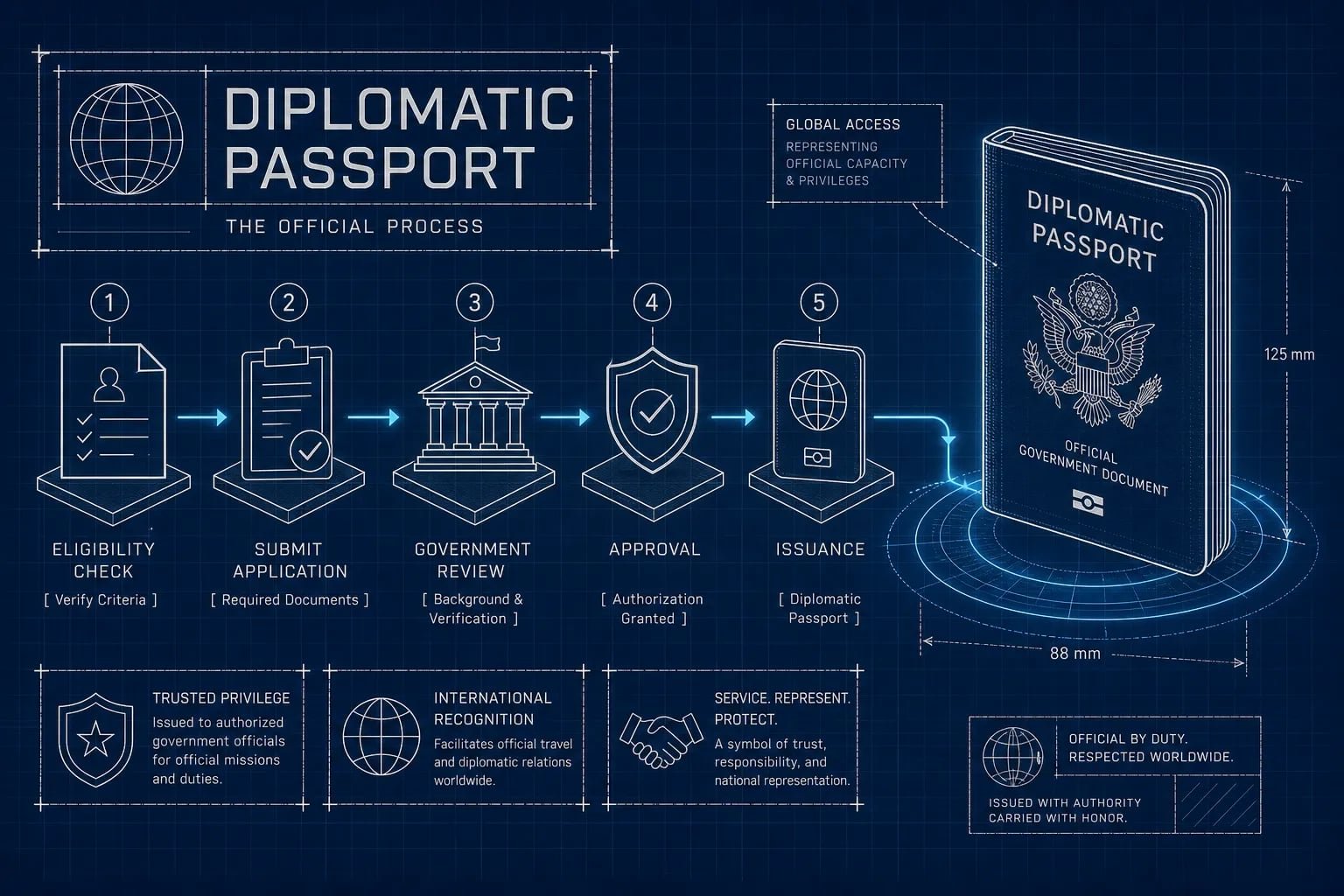
If you’ve ever asked what is the process for obtaining a diplomatic passport?, you’re already ahead of most people who pursue one, because understanding the process is exactly what separates successful applicants from those who waste months on an ineligible filing. A diplomatic passport is one of the most misunderstood travel documents in circulation. Most people assume it belongs exclusively to ambassadors, heads of state, or high-ranking political figures. The reality is more structured than that assumption suggests, and the eligibility rules are precise enough that many people who believe they qualify don’t, while some who never considered it actually do.
This guide serves two distinct reader groups. The first is U.S. government personnel navigating the official State Department application process: Foreign Service Officers, agency employees with overseas assignments, and eligible family members who need to understand the correct forms, submission channels, and timelines. The second group includes internationally mobile individuals exploring whether legal routes to diplomatic status exist outside traditional government service. Both paths are real. Both require a clear-eyed understanding of the eligibility rules before a single form gets filled out. For clients in the second group, Travel Documents Online provides confidential, expert guidance from the first conversation through to a completed application.
What is the process for obtaining a diplomatic passport? Start here.
The difference between diplomatic, official, and ordinary passports
The U.S. government issues three distinct passport types. The standard blue-cover passport is the one most Americans carry. The green official passport is issued to government employees and certain contractors traveling on official duties. The black diplomatic passport is the narrowest category: reserved for individuals with diplomatic or comparable status traveling abroad on diplomatic duties for the U.S. government. All three are issued by the State Department, but only the blue passport can be used for personal travel without restriction. Diplomatic and official passports are classified as „special-issuance“ documents and are restricted to authorized government travel.
What the passport does and does not confer
The most persistent misconception about a diplomatic passport is that carrying one grants diplomatic immunity. It does not. Possession of a diplomatic passport does not exempt the holder from foreign laws, does not allow anyone to bypass immigration screening or border security, and does not shield the holder from arrest by a foreign government. Actual diplomatic immunity is a function of the individual’s accredited diplomatic status under international law and the host country’s formal recognition of that status, not the travel document itself. The State Department has explicitly warned that holders of special-issuance passports may actually face increased scrutiny from foreign governments, not less.
Who qualifies for a U.S. diplomatic passport
Step 1: Confirm eligibility, who qualifies for a diplomatic passport?
The central eligibility question in the diplomatic passport application process is not what your job title is, but whether you have been granted diplomatic or comparable status and are traveling abroad to perform diplomatic duties on behalf of the U.S. government. Career Foreign Service Officers are expressly eligible. Other U.S. government personnel qualify when their foreign assignment grants them diplomatic or comparable status. Authorized spouses and family members of eligible principals may receive diplomatic passports when the Department specifically approves it. U.S. government contractors are eligible only when the Department authorizes it, the contractor otherwise meets the requirements, and the passport is necessary to fulfill the contractual duties. Federal employees serving abroad under Chief of Mission authority, and individuals who have been granted diplomatic or consular title by the Department of State, round out the eligible categories.
Who does not qualify and why applications get rejected
Federal employees whose duties are domestic or purely administrative don’t qualify, regardless of seniority or proximity to senior officials. Contractors who haven’t received specific Department authorization are ineligible even if they support diplomatic missions. Political appointees don’t automatically qualify based on title alone; the appointment must carry formal diplomatic status under State Department rules for the passport to be warranted. Seniority, access to government facilities, or working alongside diplomats is not the same as holding diplomatic status. Applications that conflate proximity with eligibility are rejected, and getting this determination wrong before filing costs time and damages credibility with the issuing authority.
Three legal routes to diplomatic status
Route 1: Career government service and foreign assignments
The most direct and most common route runs through official employment. Foreign Service Officers and government personnel assigned abroad under Chief of Mission authority qualify through their posted roles. This isn’t something applied for separately from outside civilian life; it flows from the nature of the job and the foreign posting. For people in this category, the question isn’t whether they qualify but whether they’re following the correct diplomatic passport application channel for their agency.
Route 2: Honorary consul appointments
Some countries appoint private citizens as honorary consuls, granting them a consular title without the full-time diplomatic role of a career officer. Depending on the appointing country and whether the State Department recognizes the title, an honorary consul appointment can meet the eligibility criterion of having been „granted diplomatic or consular title by the Department of State.“ This route is legitimate but procedurally complex. A foreign government’s appointment alone is not enough; the State Department must recognize and accredit the title, and the individual’s duties, destination, and authorization documents are all reviewed before a diplomatic passport is considered.
This is exactly where specialized guidance makes a measurable difference. Clients who want to understand whether an honorary consul appointment creates a viable, legitimate route to diplomatic status benefit from working with a firm that knows how the State Department evaluates these cases.
Travel Documents Online provides that confidential advisory support, helping clients assess whether their specific situation meets the threshold and how to pursue the process through the right channels, without missteps that could close off legitimate options.
Route 3: Investment-linked program pathways
Some countries offer programs that, through significant investment, grant participants honorary positions tied to consular or diplomatic roles. These programs exist, but they vary enormously in legal standing, host-country recognition, and compatibility with U.S. law. No country can legitimately sell a diplomatic title through an investment program in a way that creates recognized diplomatic status under international law; actual diplomatic status requires a genuine state appointment and accreditation process. Programs marketed as offering „diplomatic passports“ through investment deserve rigorous due diligence before any commitment is made. Pursuing one without expert guidance can create serious legal complications and put future diplomatic passport applications at risk. Travel Documents Online helps clients evaluate these programs confidentially, separating legitimate pathways from schemes that carry legal risk.
Documents and forms required for your diplomatic passport application
The core paperwork: DS-11, DD Form 1056, and letters of authorization
The base application for first-time passport applicants is DS-11, completed using the State Department’s Form Filler tool and printed single-sided. Department of Defense applicants must also submit DD Form 1056 along with a copy of approved travel orders. Employees of other federal agencies submit a signed letter of authorization from an authorized official, along with travel orders where applicable. State Department employees submit their request internally through Human Resources and obtain a letter of authorization from their bureau’s executive office, which then routes to the Special Issuance Agency. Every form must be completed through the official Form Filler tool available on the State Department’s website, not handwritten or typed on a generic template.
Supporting documentation by applicant type
Regardless of agency, every applicant needs a passport-quality photo taken within the past six months. Proof of U.S. citizenship is required and can be satisfied with a birth certificate, a previously issued full-validity undamaged U.S. passport, a Consular Report of Birth Abroad, or a Certificate of Naturalization or Citizenship. Every identity document submitted must be accompanied by a photocopy. If you already hold a valid special-issuance passport, that document itself can serve as citizenship evidence. Incomplete submissions, missing photocopies, or forms completed outside the official tool are among the most common reasons applications stall at the agency level.
Where to submit and how long the process takes
Domestic submission channels
Diplomatic passports are processed exclusively by the State Department’s Special Issuance Agency in Washington, D.C. Applicants do not submit to a standard passport acceptance facility. The submission channel depends on the applicant’s employing agency. State Department employees route through Human Resources and their bureau’s executive office. Department of Defense applicants submit through the relevant military passport office, such as the Pentagon Passport Office. Employees of other federal agencies work through their Agency Travel Coordinator, who submits the package either electronically or in hard copy to the agency’s International Travel Section, which then forwards to the Special Issuance Agency.
Applying abroad and timing expectations
Applicants stationed overseas submit through the nearest U.S. embassy or consulate, which accepts the package and forwards it to the Special Issuance Agency in Washington. Routine processing runs four to six weeks; expedited processing takes two to three weeks for an additional $60 fee. Mailing time can add up to two more weeks on each end unless faster return delivery is purchased. Agency guidance commonly recommends submitting at least eight weeks before the departure date to account for internal review steps before the application even reaches the Special Issuance Agency. Applicants with urgent travel within 14 calendar days require an appointment at a passport agency and must provide proof of the imminent departure.
Common misconceptions that stall or derail applications
„My passport type gives me diplomatic immunity“
The diplomatic passport is evidence of official travel status, not a legal shield. Host countries accredit diplomatic agents through a separate, formal process; the passport itself carries no immunity. Carriers of diplomatic passports who lack accredited diplomatic status may find foreign border officials scrutinizing their travel more closely, not waving them through. Setting realistic expectations about what this document enables is essential before applying, and applicants who misrepresent their status to obtain one face serious consequences.
Other myths that cost applicants time and credibility
Several additional misconceptions routinely cause problems in the diplomatic passport application process:
- A political appointment does not automatically qualify someone for a diplomatic passport. What matters is whether the role carries formal diplomatic status under State Department rules, not the prestige of the position.
- An official passport and a diplomatic passport are not interchangeable. They are issued for different eligibility categories and serve different purposes.
- A diplomatic passport cannot be used for personal travel, with the narrow exception of entering or exiting the country of assignment and returning to the United States.
- When the qualifying assignment or role ends, the passport must be returned to the government. It does not become a personal travel document that the former holder keeps.
Navigating the process for obtaining a diplomatic passport with confidence
Understanding what is the process for obtaining a diplomatic passport comes down to a disciplined sequence: confirm whether you qualify, identify which legal route applies to your situation, assemble the correct forms and supporting documents for your agency type, route your application through the proper submission channel, and build in enough lead time. For government employees with a clear foreign posting and the right eligibility, this process is navigable with the right information and a disciplined approach to paperwork.
For individuals exploring honorary consul appointments or investment-linked pathways, the process is significantly more opaque. The eligibility thresholds are harder to evaluate without specialized knowledge of how the State Department reviews these cases, and the stakes of getting it wrong are higher. A misstep at the eligibility determination stage can close off legitimate pathways and create complications that are difficult to reverse.
Travel Documents Online works confidentially with clients who are navigating the more complex pathways to diplomatic status. Our team provides expert guidance on whether a specific situation meets the eligibility criteria and how to pursue the diplomatic passport application process through legitimate, recognized channels. If you’re in that second group and want a clear-eyed assessment of your options, reach out to start the conversation.