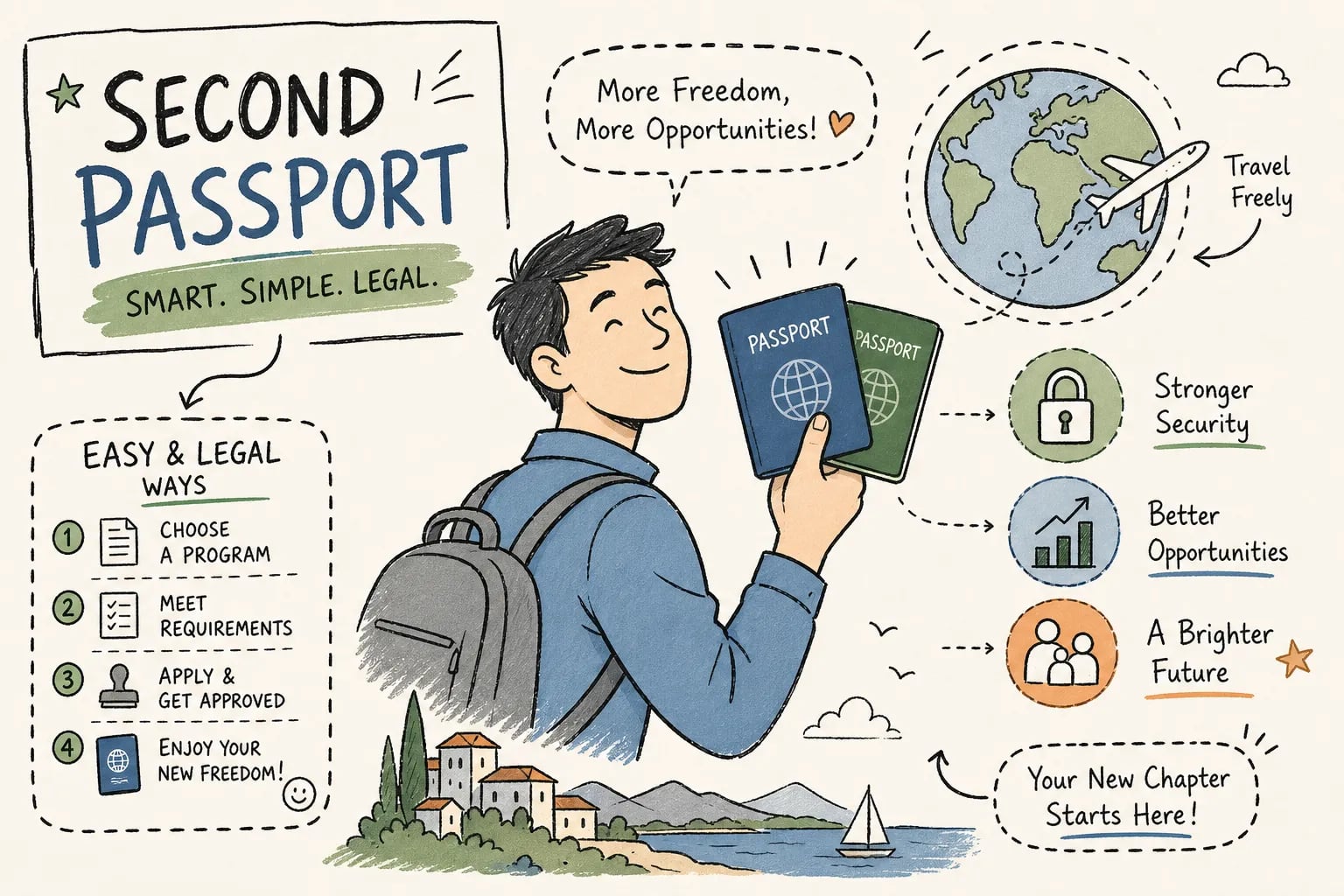
Many people assume that getting a second passport is reserved for billionaires with offshore accounts or diplomats with political connections. That assumption is wrong, and it’s costing ordinary people real options. A second citizenship can mean the difference between weeks of visa processing and boarding a flight on short notice. It can mean a backup home for your family, expanded business access, or simply more freedom to move through the world on your own terms.
There are four distinct legal routes to a second passport, and each one serves a different type of person. They differ in cost, timeline, eligibility, and the amount of life disruption they require. One route costs nothing beyond document fees but demands patience. Another costs a significant sum but can deliver a passport in under six months. Understanding which path fits your situation is the entire game.
Travel Documents Online provides international passport, citizenship, and residency document services to clients throughout the United States and internationally. This guide distills hard-won process knowledge into a clear, practical breakdown so you can identify your fastest legal path to dual nationality and take your next concrete step with confidence.
The four legal routes to a second passport, and what each one costs in time
Route 1: Citizenship by investment
Citizenship by investment is the fastest legal route available today. You make a qualifying financial contribution or real-estate purchase, pass a government-administered due-diligence review, and receive citizenship without relocating to the country. There is no language test, no civics exam, and no residency clock to run out.
Typical processing runs 3 to 9 months for established programs, though some cases stretch to 12 to 18 months depending on the program and application complexity. This route is best suited to high-net-worth individuals and entrepreneurs who need speed and cannot, or do not want to, uproot their lives to qualify.
Route 2: Passport by descent
If a qualifying parent, grandparent, or in some cases a more distant ancestor held citizenship in another country, you may be entitled to claim that citizenship today. The process requires assembling documented proof of lineage: birth records, marriage certificates, and citizenship documents that form an unbroken chain from the qualifying ancestor to you.
Timelines range from about 6 months in straightforward, well-documented cases to 5 or more years for complex lineage chains or claims filed with backlogged consulates. When eligibility is clear and records are accessible, this is the least expensive legal route by a wide margin. The real cost is time and the effort of locating historical documents.
Route 3: Naturalization through residence
The most widely available route globally is also the most demanding in terms of personal commitment. You move to a country lawfully, satisfy physical-presence requirements over a statutory period, meet any language or civics standards, and then apply for citizenship. The statutory period typically runs 3 to 10 years, followed by 6 to 18 months of processing.
This route works best for people who are already planning a long-term relocation. If moving abroad is part of your life plan, naturalization aligns naturally with that decision. If relocation isn’t already on the table, this route requires changing your life to fit the requirement.
Route 4: Marriage to a citizen
Marrying a citizen of another country opens an expedited naturalization pathway in many jurisdictions, but marriage alone does not automatically transfer citizenship. Governments routinely verify that the relationship is genuine through interviews, cohabitation checks, and documentation reviews before approving an application. Typical supporting documentation includes joint financial records, shared lease or mortgage agreements, and correspondence that establishes a genuine shared life.
Typical timelines run 1 to 5 years depending on the country’s specific residence and cohabitation requirements. This is an eligibility-driven route: if the marriage is real and the legal requirements are met, the process is legitimate. It is not a shortcut you can engineer.
Fastest citizenship-by-investment programs in 2026
Countries with the shortest processing windows
Three programs currently stand out for sheer speed. Vanuatu processes complete applications in approximately 30 to 90 days, requires no site visit, and allows fully remote processing. The minimum contribution is around $130,000 for a single applicant, with a realistic all-in total of $145,000 to $155,000 once government fees and professional costs are included. São Tomé and Príncipe advertises a 4 to 10-week window with a minimum around $90,000, though real-world timelines can run longer in practice. Nauru is processing in 3 to 4 months, with a minimum around $90,000 under a 2026 promotional window. All figures should be verified against each program’s current official documentation, as pricing and terms shift more frequently than most applicants expect.
Caribbean programs: established and widely recognized
The Caribbean citizenship-by-investment programs carry more global recognition than the smaller Pacific and African options, and for many clients that recognition matters enormously. The main programs in 2026 are as follows:
- St. Kitts and Nevis: minimum $250,000 contribution; approximately 2 to 5 months processing; among the most widely recognized CBI passports available.
- Grenada: minimum $235,000 contribution; approximately 3 to 6 months; the only Caribbean CBI program with E-2 Treaty Investor Visa access to the United States, a significant advantage for American investors.
- Dominica and Saint Lucia: minimum contributions of $200,000 to $240,000; processing of 2 to 4 months; straightforward documentation requirements and no relocation requirement.
- Turkey: real-estate purchase of at least $400,000; processing of 3 to 6 months; a strong business-travel passport, though the financial threshold is higher than Caribbean contribution programs.
One number to keep in mind: the headline contribution is not the total cost. Government fees, due-diligence fees, and professional fees add meaningfully to every program’s headline figure. For Grenada, a single-applicant all-in cost realistically lands around $255,000 to $270,000. Always request an itemized written quotation before transferring funds to any program, and confirm figures directly with the relevant government or an authorized agent.
Passport by descent: which countries make it easiest
One-generation claims requiring only a qualifying parent
The documentation burden drops significantly when only one generation separates you from the qualifying ancestor. Germany, Mexico, Brazil, and Australia generally require only one qualifying parent. The core documents are typically your birth certificate, your parent’s citizenship or birth record, and marriage records where surnames differ between documents. Australia and Germany both have additional rules about whether citizenship was actually held and transmitted at the time of your birth, so the exact date and circumstances of the parent’s citizenship status matter.
Grandparent routes with relatively clear rules
Ireland stands out as one of the cleaner grandparent routes available. An Irish-born grandparent typically qualifies you to register through the Foreign Births Register. The documentation chain runs grandparent to parent to you, requiring original civil birth certificates at each generation, marriage certificates wherever surnames differ, and certified identification or death certificates for deceased qualifying ancestors. Portugal offers a grandparent route under certain conditions, with potential language requirements depending on the specific pathway. Israel allows Jewish descent through a parent or grandparent to qualify under the Law of Return, subject to identity and eligibility verification.
What „minimal documentation“ still means in practice
No descent claim is truly documentation-free. Every route requires the applicant’s birth certificate, the qualifying ancestor’s birth or citizenship record, marriage certificates bridging each generation, and apostilles or certified translations for any documents issued abroad. The practical shortcut is locating an official citizenship record for the qualifying ancestor first. That single document can transform a multi-year records search into a manageable project with a clear endpoint.
One important note on Italy: Italy’s descent rules have tightened considerably in 2026. Eligibility now depends heavily on specific ancestors, the dates involved, and the citizenship transmission chain. Verify current requirements directly with the relevant Italian consulate before ordering any records, because administrative changes in recent years mean that a pathway that was viable previously may not apply to your specific lineage today.
Naturalization through residence: realistic timelines for 2026
Portugal, Spain, and Canada compared
Portugal’s residency-to-citizenship route underwent significant changes in 2026. Most non-EU nationals now need 10 years of qualifying residence before applying, while EU nationals and citizens of Portuguese-speaking countries may qualify at 7 years. After filing, processing adds approximately 2 to 3 years in practice for a typical case, meaning applicants should plan conservatively for 12 to 14 years total from starting the residency process. Applications already pending by May 18, 2026 may remain protected under the former five-year rules; new applicants should verify their position carefully before making plans based on older guidance.
Spain’s standard route requires 10 years of lawful, continuous residence, with processing adding another 1 to 3 years. The exception is meaningful: nationals of most Latin American countries qualify after just 2 years, making the practical end-to-end timeline roughly 3 to 5 years for those nationalities. For Americans on the standard route, the realistic window runs 11 to 13 years. Canada requires 1,095 days of physical presence within the five years before applying while holding permanent-resident status. Most applicants reach citizenship 4 to 6 years from initial arrival if permanent residency comes relatively quickly, though processing backlogs and appointment scheduling typically extend the passport date beyond the eligibility date.
The gap between statutory eligibility and your actual passport date
The statutory residence period is the earliest point at which you can file an application. It is not the date your passport arrives. Language and civics requirements, criminal-record checks, documentation preparation, appointment scheduling, and government processing queues all add time between filing and receiving citizenship. Physical presence is the non-negotiable element in all three countries. Holding a residence permit while living primarily elsewhere does not satisfy the requirement and will disqualify an otherwise eligible application.
What Americans need to know before pursuing dual nationality
The US government’s position on dual citizenship
The United States generally permits dual nationality and does not require citizens to renounce US citizenship when they naturalize in another country. A US citizen who naturalizes abroad does not automatically lose their US citizenship, provided the action is voluntary and not intended to relinquish it. The practical implication is that most Americans pursuing a second passport through any of the four routes can do so without triggering a loss of their US citizenship.
Both countries‘ laws, tax obligations, and travel requirements apply simultaneously once you hold dual nationality. Compliance with FATCA and foreign-asset reporting rules is a real and ongoing obligation for Americans with foreign citizenship or residency. Under IRS and FinCEN guidelines, Americans with foreign financial accounts and assets above certain thresholds must file FBAR (FinCEN Form 114) and IRS Form 8938, among other reporting requirements. Non-compliance carries substantial civil and criminal penalties. Any American pursuing a second passport should engage qualified tax counsel before or immediately after obtaining foreign citizenship.
Entering and exiting correctly
US citizens must enter and exit the United States on a valid US passport. A foreign passport cannot substitute for US travel, even if the other country requires its own passport for entry into their territory. When you are in the country of your other nationality, US consular assistance may be limited because that country may treat you solely as its own citizen, restricting US consular access in difficult situations.
Grenada’s CBI program is particularly relevant for American investors for one specific reason: Grenada citizenship opens a pathway to apply for an E-2 Treaty Investor Visa to live and work in the United States. This option is unavailable through most other CBI programs and creates a notable combination of offshore citizenship and US business access that no other Caribbean program currently offers.
Choosing the right route and taking your next step
Matching your situation to the right pathway
There is no universal answer to which route is „easiest.“ The right path depends entirely on your timeline, budget, ancestry, and mobility goals. Four situations point clearly to four different routes:
- Speed is the priority: citizenship by investment, with Vanuatu or the Caribbean programs leading on processing time.
- Budget is the primary constraint: passport by descent, if ancestry qualifies, with no investment required beyond document retrieval and professional fees.
- Long-term relocation is already planned: naturalization through residence in Portugal, Spain, or Canada aligns naturally with a life-change decision.
- American investors wanting both a second passport and US business access: Grenada CBI is the only Caribbean program with E-2 Treaty access to the United States.
The concrete next steps
Start with two checks before committing to any route. First, confirm whether your current country permits dual citizenship. Second, trace your ancestry back two to three generations and determine whether any qualifying lineage exists. If descent eligibility exists, it is almost always the most cost-effective path, and the research required to confirm it is minimal compared to the potential value.
If you’re pursuing a CBI program, verify the program’s current rules, authorized agents, total fee structure, and due-diligence requirements directly through official sources. Programs change their rules, pricing, and passport-access terms more frequently than most people realize, and an outdated figure from a years-old article can lead to a very expensive misunderstanding.
Working with an experienced team removes the guesswork from a process that is genuinely complex. The specialists at Travel Documents Online coordinate application strategy, document preparation, consular liaison, and timeline management across all four routes for clients throughout the United States and internationally. The next step is not more research; it’s a structured conversation with someone who has navigated these exact processes across dozens of countries and client situations. Reach out to our team directly to begin your assessment.
The bottom line on legal routes to a second passport
Four routes, four different trade-offs. Citizenship by investment is the fastest and most expensive, requiring no relocation but a significant financial commitment. Passport by descent is the least expensive when eligibility exists, but documentation research and consulate backlogs require patience. Naturalization through residence is the most broadly available option globally but demands genuine relocation and years of physical presence. Marriage to a citizen opens an expedited path where the relationship is genuine and the legal requirements are met.
The easiest legal route to a second passport is the one that fits your actual situation. Your timeline, your ancestry, your budget, and your mobility goals determine the answer, not a general ranking of which program sounds most appealing. Take the time to match your circumstances to the right pathway before investing money or years into a route that doesn’t fit your life.
When you’re ready to move from research to action, the team at Travel Documents Online is here to guide you through every step, from initial eligibility assessment to application submission, document coordination, and final passport delivery. Get in touch with our team to start your confidential consultation today.