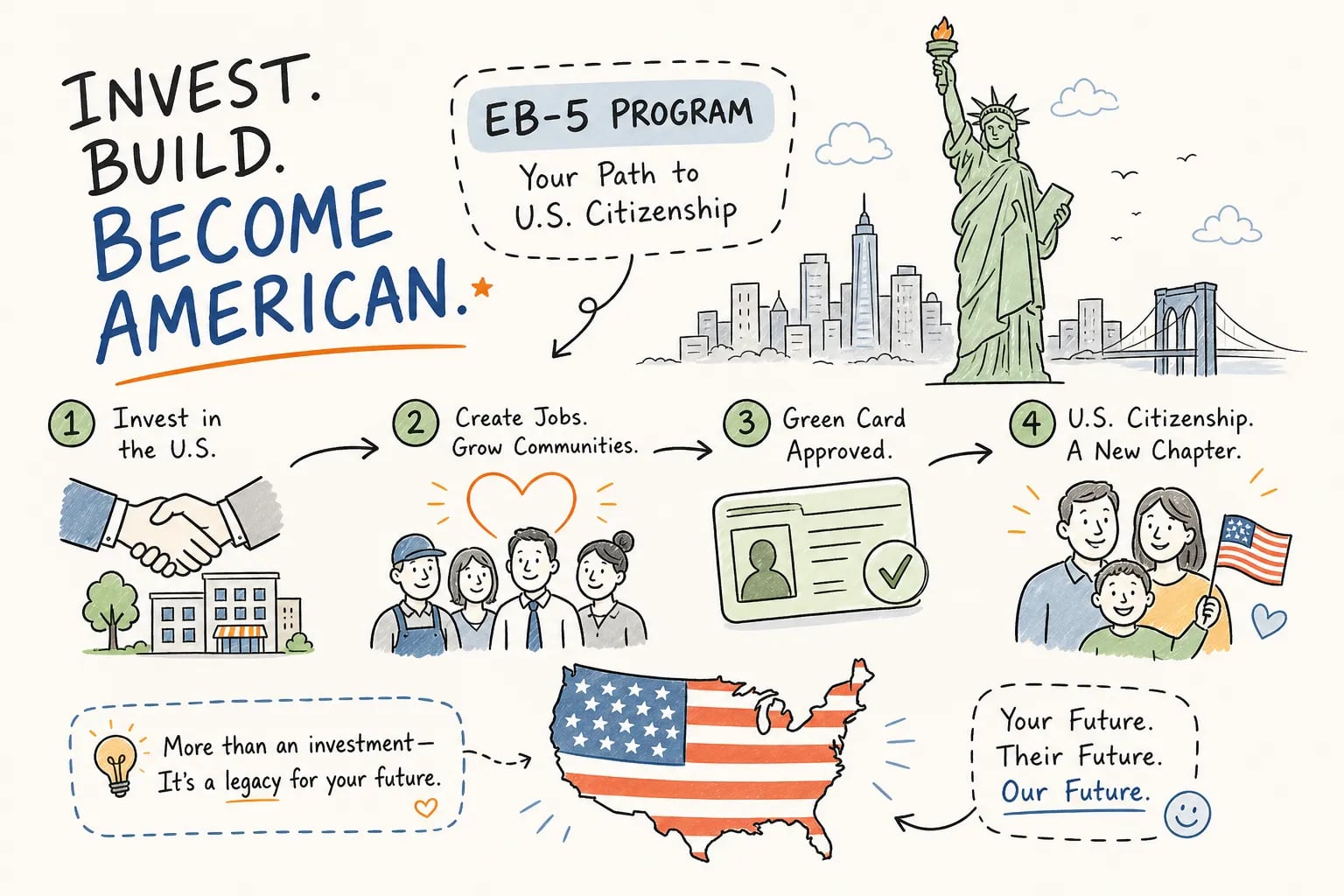
Every week, investors from around the world search for „citizenship by investment USA,“ expecting to find a program similar to what Grenada or St. Kitts and Nevis offer: a qualifying investment, a quick review process, and a passport in hand within months. The reality is fundamentally different. The United States does not sell citizenship, and it never has. What exists instead is the EB-5 Immigrant Investor Program, a federally administered pathway to permanent residency that can eventually lead to naturalization, but only after years of sustained compliance, significant capital commitment, and rigorous documentation.
Investors from the U.S., Europe, and Asia come to Travel Documents Online with exactly this question. Some are the right fit for EB-5. Many are better served by faster international pathways. Understanding the difference starts with understanding what EB-5 actually requires and what it demands of you. This article breaks that down clearly so you can make a decision that fits your real situation.
What the U.S. actually offers investors seeking permanent status
The U.S. operates on a residency-first model. Investment can open a door to a green card through EB-5, but citizenship is a completely separate process governed by naturalization law, and the investment itself never guarantees it. This is a fundamental distinction from Caribbean citizenship by investment programs, where citizenship is the direct and contractual outcome of a qualifying investment.
The structure follows three stages. First, you qualify and file for EB-5 investor status by meeting the investment and job-creation requirements. Second, you obtain conditional permanent residence, and then remove those conditions to hold a standard green card. Third, after five years as a lawful permanent resident, you meet the continuous residence, physical presence, English language, civics, and good moral character requirements to apply for naturalization. Approval at the naturalization stage is not automatic, even after a decade of compliant residency.
The practical implications matter for planning. Tax obligations begin the moment you become a U.S. resident. Physical presence requirements apply independently of your investment. A denial at naturalization is genuinely possible even after years of green card status. Investors need to plan for the full lifecycle of this process, not just the initial capital outlay.
How the EB-5 program is structured in 2026
The current investment minimums are $800,000 for projects located in a targeted employment area (TEA) and $1,050,000 for standard non-TEA projects. The lower threshold also applies to qualifying infrastructure investments. These figures are subject to inflation-adjustment changes beginning in 2027, so confirm the current amounts before filing.
A TEA is designated either as a rural area (outside a metropolitan statistical area and outside any city with a population of 20,000 or more) or as a high-unemployment area with unemployment at least 150% of the national average. USCIS controls TEA designation under current rules; a state-issued TEA letter alone does not determine federal eligibility.
Investors can participate in EB-5 through two structures. In a direct EB-5, you invest in and often help manage an operating business, with all 10 qualifying jobs documented through payroll records. In a regional center EB-5, your capital pools with other investors into a larger development, typically real estate or infrastructure, and the job count can include indirect and induced economic employment. Each model carries distinct risk profiles, documentation requirements, and levels of investor control. Neither is inherently safer; both require thorough due diligence before committing capital.
The 10-job creation rule: what actually qualifies
Direct EB-5 job rules
Every EB-5 investor must create at least 10 new full-time jobs for qualifying U.S. workers. Qualifying employees include U.S. citizens, lawful permanent residents, refugees, asylees, and other authorized workers. The investor, their spouse and children, and any nonimmigrant visa holders are explicitly excluded from the count. Jobs must be full-time, defined as at least 35 hours per week, and expected to last at least two years.
For direct EB-5, only jobs with a documented employer-employee relationship count toward the requirement.
Regional center job methodology
For regional center projects, up to 90% of the 10-job threshold can be satisfied through indirect and induced employment demonstrated via recognized economic methodologies. A specific exception applies to qualifying construction activity lasting less than two years: indirect jobs can satisfy up to 75% of the requirement, meaning at least 25% must be direct jobs.
Job creation methodology is one of the most scrutinized elements of any EB-5 petition. Underdeveloped business plans, flawed economic projections, and misclassified employment relationships drive a significant share of requests for evidence and outright denials. If you’re evaluating a regional center project, request the underlying economic report before you commit capital. The numbers in a marketing brochure are not the same as a defensible USCIS filing.
Citizenship by investment USA vs. EB-5: understanding the timeline
I-526 or I-526E adjudication currently takes roughly 12 to 36 months, though individual cases vary considerably. After petition approval, the investor must wait for a visa number to become available. For applicants from countries without a backlog, this can be near-immediate. For investors from high-demand countries, visa backlogs can add years to the overall process. Conditional permanent residence is typically granted 6 to 18 months after visa availability and petition approval.
All EB-5 investors enter the U.S. as conditional permanent residents for exactly two years. The I-829 petition to remove conditions must be filed within the 90-day window before that two-year anniversary. Current I-829 adjudication timelines run approximately 12 to 30 months. An unconditional green card typically arrives 4 to 7 years after the initial petition filing, assuming no backlog complications.
The five-year continuous residence requirement for naturalization begins from the date conditional permanent residence was granted, not from when the I-829 is approved. This means an investor may become eligible to file Form N-400 around the fifth anniversary of their conditional green card, even if the I-829 is still pending. The physical presence requirement is also separate: at least 30 months physically in the U.S. during those five years. Total time from first petition to naturalization approval typically runs 5 to 8 years without a backlog, and longer for high-demand nationalities.
The real cost of EB-5 and why petitions get denied
Government fees add up quickly beyond the investment capital itself. Filing Form I-526 or I-526E costs $3,675. The I-526E Integrity Fund fee adds another $1,000. Form I-829 runs $3,750. Consular processing, biometrics, and adjustment of status fees add to the total. Regional center administrative fees average around $70,000 but vary widely by project. Add attorney fees for the petition, source-of-funds documentation, I-829 filing, and naturalization application, and non-investment costs can easily exceed $100,000 before the capital requirement is even factored in.
The three core filings each carry distinct documentation demands:
- I-526/I-526E: Establishes investor eligibility, the qualifying investment, and the job-creation plan. Source-of-funds tracing is the most heavily scrutinized component and the most common reason for RFEs and denials.
- I-485 or DS-260: Handles adjustment of status (if in the U.S.) or consular processing (if abroad) for the actual green card issuance.
- I-829: Demonstrates that conditions were met: capital remained at risk, the investment was sustained, and 10 qualifying jobs were created.
Denial rates vary significantly by petition type. USCIS data through FY2026 Q3 shows I-526E denial rates running close to 25% in recent quarters, while legacy pre-RIA I-526 petitions face denial rates above 60% in some reporting periods. The most common failure points are incomplete or inconsistent source-of-funds tracing, investments not properly documented as being at risk, inadequate business plans, job-creation methodology gaps, and regional center compliance problems. A rejection for a procedural defect differs from a denial on the merits, but both derail a case. The quality of your RFE response often determines whether the petition survives.
Faster alternatives when EB-5 doesn’t fit your situation
The E-2 treaty investor visa allows nationals from treaty countries to invest in and manage a U.S. business, but it does not provide a green card or any pathway to citizenship. It is a renewable nonimmigrant visa, useful for operational flexibility but not for building a permanent U.S. residency base. Americans themselves cannot use E-2 domestically, though U.S. investors who hold a qualifying foreign nationality can use it for business access in a treaty country.
For investors who want a second passport without a decade-long commitment, Caribbean citizenship by investment programs offer a fundamentally different proposition. Grenada’s program delivers full citizenship in roughly 4 to 6 months with a contribution starting at $235,000. St. Kitts and Nevis processes applications in a similar window, with an entry point of $250,000. Dominica has historically offered one of the lower-cost options in the Caribbean at around $200,000. These programs are not a path to U.S. citizenship, but they provide genuine international mobility, often within the same calendar year you decide to act.
Grenada’s program carries a specific strategic advantage for U.S.-focused investors. As a Grenadian citizen, an investor becomes eligible to apply for the U.S. E-2 treaty investor visa, a route not available to many other nationalities. This requires establishing genuine domicile in Grenada for at least three years following citizenship acquisition and funding a separate, qualifying U.S. business investment. It is not a shortcut to a green card, but it creates meaningful operational access to the U.S. market through a legal, treaty-based channel.
Choosing between EB-5, a Caribbean citizenship by investment USA alternative, a Golden Visa, or another international residency pathway depends on factors specific to your situation: investment size, timeline, tax profile, family structure, and what you actually need from a second document. The team at Travel Documents Online works directly with investors navigating exactly these decisions. If you want a confidential, personalized assessment of your options, reach out to our team to map out a strategy built around your goals.
The bottom line on U.S. investor pathways
The United States does not offer citizenship by investment in the way the term is commonly understood. EB-5 is a legitimate, federally administered residency-by-investment program that can lead to naturalization, but it demands significant capital, a long timeline, rigorous documentation, and real tolerance for process uncertainty. For investors with the right profile and a genuine need for U.S. permanent residency, it remains a viable route worth serious evaluation.
For those exploring citizenship by investment USA options more broadly, Caribbean CBI programs and other international residency pathways deserve equal consideration. These programs are not in competition with each other, they solve different problems for different investor profiles. Travel Documents Online helps you identify which approach fits your actual goals. Contact our team for a confidential assessment and we’ll build a strategy around your specific situation.
Frequently asked questions about citizenship by investment USA
Does the U.S. have a citizenship by investment program?
No. The United States does not offer direct citizenship in exchange for investment. The EB-5 program grants conditional permanent residency, which can lead to naturalization after at least five years, but citizenship is never a guaranteed or contractual outcome of the investment itself.
How much does EB-5 cost in total?
The minimum investment is $800,000 for TEA-designated projects or $1,050,000 for standard projects. Beyond that, investors typically pay $70,000 or more in regional center administrative fees, $3,675 to file the I-526E petition, $3,750 for the I-829 filing, plus attorney fees and government processing costs that can push total non-investment expenses well above $100,000.
How long does EB-5 take to reach citizenship?
For investors from countries without a visa backlog, the path from first filing to naturalization typically takes 5 to 8 years. For high-demand nationalities such as those from China or India, the timeline can extend significantly longer due to visa queue backlogs.
What are the fastest citizenship by investment USA alternatives?
Caribbean programs such as Grenada, St. Kitts and Nevis, and Dominica offer citizenship in 4 to 6 months at investment levels starting around $200,000. These are not U.S. citizenship programs, but they provide genuine passport mobility and, in Grenada’s case, a potential route to U.S. E-2 visa eligibility.
Can I lose my EB-5 investment?
Yes. EB-5 capital must be placed „at risk“ as a legal requirement, which means there is no guarantee of return. Regional center projects have failed, leaving investors without their capital or their green card. Thorough due diligence on any project is essential before committing funds.